
Semi-Solid Die Casting (SSM) | T6 Heat-Treatable Aluminum Parts
Leading Semi-Solid Rheocasting (SSM) solutions for zero-porosity, high-density structural components. Fully compatible with A356/A357 T6 heat treatment for automotive & aerospace OEM parts.
Request a QuoteAdvanced Rheocasting Technology
The Ultimate Solution for Heat-Treatable Aluminum Components. Achieve Zero-Porosity, Forge-Density Structural Parts Tailored for Automotive and Aerospace Engineering.
**
T6 Heat Treatable
Unlike standard HPDC options, authentic SSM components are fully compliant with advanced T6 solution and aging matrix runs to maximize mechanical threshold yield.
**
Zero Porosity
Engineered laminar slurry front filling completely isolates air-trapping zones, guaranteeing 100% pressure-tight seal conditions without impregnating adjustments.
**
Superior Precision
Operating with lower solidus slurry bands significantly cushions thermal strain thresholds onto tool molds, ensuring extended lifetime tracking and closer tolerances.
The Science
Semi-Solid Slurry Behavior vs. Conventional Cavity Fills
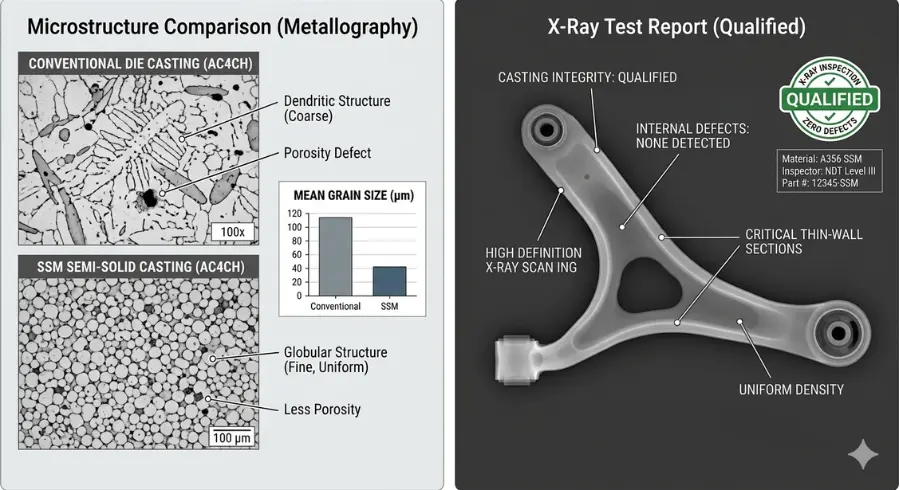
Standard High-Pressure Die Casting (HPDC) shoots molten metal into the mold cavity at extremely high velocities, creating severe turbulence that traps gas and causes internal micro-porosity. This completely prevents secondary T6 heat treatment, as high temperatures cause the trapped gases to expand, creating structural surface blistering.
Our specialized Semi-Solid Rheocasting process utilizes a controlled slurry mix where the alloy remains precisely in a semi-solid state. This globular microstructure flows uniformly into the tool steel matrix via a stable, progressive laminar front—eliminating air pocket creation and establishing forge-density alignment.
 Target Industries
High-Integrity Structural Parts for Mission-Critical Assemblies
Where high mechanical loading, component lightweighting, and structural integrity are non-negotiable parameters, SSM components replace expensive multi-part fabrications and raw forgings.
- **Automotive Chassis Hardware: Steering knuckles, suspension control arms, structural shock towers, and engine subframes.
- **E-Mobility & Powertrains: Structural EV battery housings, liquid-cooled inverter casings, and high-strength motor bracket mountings.
- **Pneumatic & Hydraulics: Critical gas valve blocks, regulator manifolds, and airtight pneumatic cylinder components.
Process Parameters:
SSM vs. Traditional HPDC
Review the definitive metallurgical differences between standard high-pressure die casting and semi-solid rheocasting methods. If you are still deciding between the two mainstream pressure processes themselves, our comparison of low-pressure and high-pressure casting treats that choice separately.
| Performance Metric | High-Pressure Die Casting (HPDC) | Semi-Solid Die Casting (SSM) |
|---|---|---|
| Internal Gas Porosity | Common / Moderate to High Voids | Near-Zero / Full Metallurgical Density |
| T6 Solution Heat Treatment | Not Possible (Leads to Surface Blistering) | Fully Compatible (Maximizes Tensile Strength) |
| Mechanical Integrity | Standard / Baseline Brittle Limits | High Ductility & Forge-Like Fatigue Resistance |
| Component Wall Geometry | Restricted Uniform Layouts (Typically 1.5mm – 6mm) | Excellent for Thick Cross-Sections & Variable Walls |
| Die Steel Shot Lifetime | Standard Cycle Burnout (High Thermal Shock) | Significantly Extended (Reduced Liquid Erosive Wear) |
Frequently Asked Questions
Get instant answers regarding the deployment of semi-solid metal processes for your production requirements.
Upgrade to Semi-Solid Performance
Ready to eliminate internal porosity defects and reinforce the structural loading capacities of your custom component designs? Secure an expert evaluation today.
**
Comprehensive DFM Review Included
Our senior technical teams provide complimentary mold-flow analyses and alloy thickness validations to optimize rheocasting fill patterns.
**
Fast-Track Engineering Turnaround
Receive a complete itemized raw material, tooling layout, and unit cost production breakdown proposal within 24 business hours.
Frequently Asked Questions
Why is semi-solid casting better for heat treatment than standard die casting?
Standard liquid die casting injects metal at excessive fluid speeds, trapping gas bubbles within the matrix. During a T6 solution heat treatment cycle (often exceeding 500°C), these compressed gases expand rapidly, leading to major surface blistering and part rejection. Semi-solid metal moves as a thick, viscous, laminar front, keeping gas completely out of the tool block to allow clean, seamless heat-treatment runs.
Which aluminum alloys are optimized for the Semi-Solid Metal process?
We highly specialize in casting A356 and A357 hypoeutectic structural alloys. Their specific silicon-magnesium structural window provides excellent thermodynamic slurry consistency, allowing us to build perfectly spherical, globular non-dendritic microstructures that react remarkably well to age-hardening parameters.
Is semi-solid casting cost-effective for medium to high-volume projects?
Yes. While initial setup verification and specialized tooling design require a higher baseline investment compared to simple HPDC, it dramatically reduces field failure rates for pressure-tight applications. By cutting downstream leak scrap to near-zero and avoiding secondary polymer sealing or forging stages, it delivers lower total cost of ownership (TCO) across complex automotive and industrial production lifetimes.
Ready to start your project?
Talk to AlumCasting engineers about your casting, machining and tooling requirements.