
Precision Die Casting for Medical Equipment
AlumCasting delivers aluminum and magnesium precision die casting for medical equipment and device components — with material traceability, PPAP Level 3 documentation, and X-ray porosity control for regulated programs.
Request a QuoteEngineering perspective from AlumCasting’s precision die casting team
Medical equipment demands a level of reliability that consumer products never face. A structural bracket inside a diagnostic instrument, or a lightweight housing for a surgical assistive device, is not judged on price alone — it is judged on traceability, repeatability, and the confidence that every cavity filled was filled the same way. At AlumCasting we apply aluminum and magnesium precision die casting specifically to meet that bar.
Precision Die Casting for Medical Equipment
Precision die casting produces net-shape medical components with tight, repeatable dimensional discipline and excellent surface integrity. For equipment manufacturers, that means fewer secondary operations, lighter assemblies, and a stable supply of geometrically consistent parts. Where a program once defaulted to CNC-machined billet for a medical housing, a properly engineered die casting can deliver the same envelope at a fraction of the recurring cost — provided the process discipline is in place from the first shot.
Medical Equipment Applications
Die-cast aluminum and magnesium appear across a widening set of medical and life-science applications:
- Diagnostic and imaging equipment housings — rigid, EMI-shielded enclosures for scanners and analyzers.
- Surgical assistive device structures — lightweight frames and arms where strength-to-weight matters.
- Patient-monitoring and wearable enclosures — thin-wall, ergonomic shells with integrated mounting features.
- Fluid-handling and connector bodies — leak-path-critical components for pumps and delivery systems.
- Mobility and rehabilitation hardware — structural brackets and joints for assistive mobility products.
Each application carries its own envelope, wall-thickness, and surface-condition requirements; the value of die casting is delivering all of them consistently at volume.
Material Selection and Chemical Resistance
Medical environments are unforgiving on surfaces. Components may face repeated sterilization cycles, cleaning chemistries, and bodily fluids. We select alloys and post-treatments accordingly:
- Aluminum alloys (e.g., A380, ADC12, A356) for structural and thermal-management parts, with optional passivation or anodizing-type surface treatments that resist corrosion and simplify cleaning validation.
- Magnesium alloys (e.g., AZ91D, AM60B) where ultra-lightweighting is decisive, finished with sealed conversion coatings such as chromate-free passivation for hygiene-critical use.
- Chemical-resistance planning is built into the DFM stage — surface finish, coating choice, and drainage geometry are specified so that cleaning agents and disinfectants do not degrade the part over its service life.
We do not treat surface chemistry as decoration. For medical programs it is part of the functional specification.
Precision, Quality, and Process Control
Achieving medical-grade consistency from a high-pressure die casting cell depends on controlled variables, not hope:
- Closed-loop cold-chamber cells with automated ladling and robotic extraction to remove human variability.
- Porosity control via vacuum-assisted HPDC and verified gating, supported by real-time X-ray inspection of critical features.
- Dimensional discipline verified on coordinate measuring machines (CMM) against the print callouts that matter to the assembly.
- Material verification by spectrometer on every melt heat before injection.
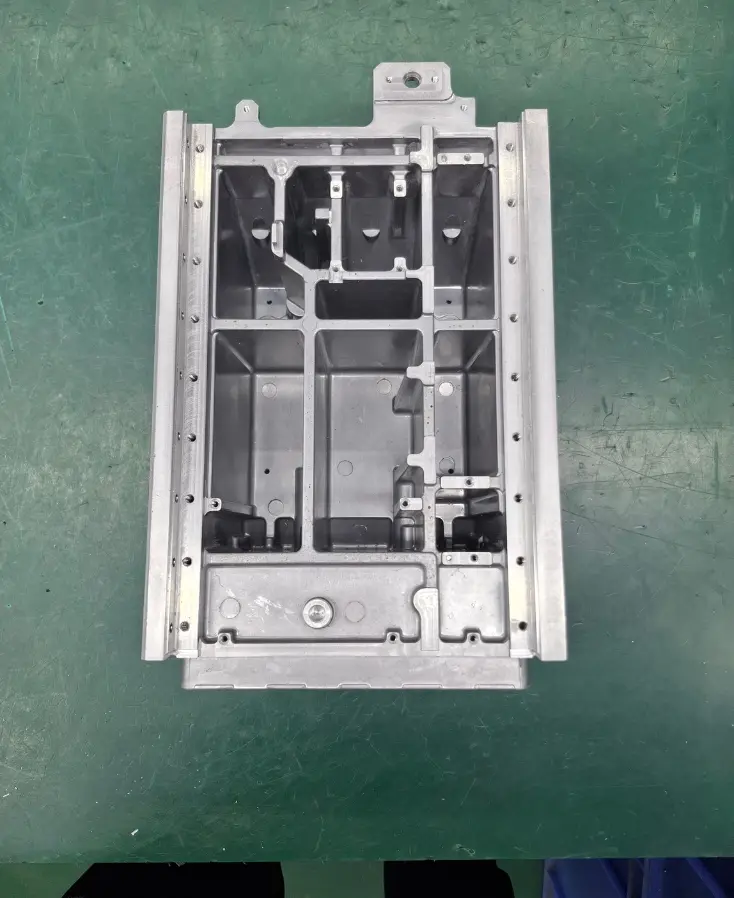 Precision-cast structural components with controlled internal integrity — the foundation of medical-grade repeatability.
Medical Component Capability Evaluation Matrix
| Capability | Why it matters for medical | AlumCasting approach |
|---|---|---|
| Material traceability | Regulated programs require lot-level accountability | Ingot heat certificates + per-melt spectrometry records |
| Dimensional repeatability | Assembly fit and device performance | CMM verification + closed-loop process control |
| Internal integrity | Hidden voids cause late-stage failure | Vacuum HPDC + X-ray NDT on critical features |
| Surface & corrosion resistance | Sterilization and cleaning cycles | Passivation / anodizing-type finishes specified in DFM |
| Documentation | Auditable quality records | PPAP-aligned package (see below) |
This matrix is the lens we use to decide whether die casting — rather than machining or fabrication — is the right basis for a given medical component.
PPAP and Quality Documentation
Medical and regulated-industry customers expect disciplined documentation. AlumCasting supports programs with a PPAP Level 3 documentation set: design records, material and process certifications, dimensional results, capability studies, and a controlled change history. Full traceability from raw ingot to finished, inspected component is treated as a baseline requirement, not a premium add-on.
For programs that also need machined features, our integrated precision CNC machining and medical device component machining capabilities carry the casting through to final tolerance in one accountable workflow.
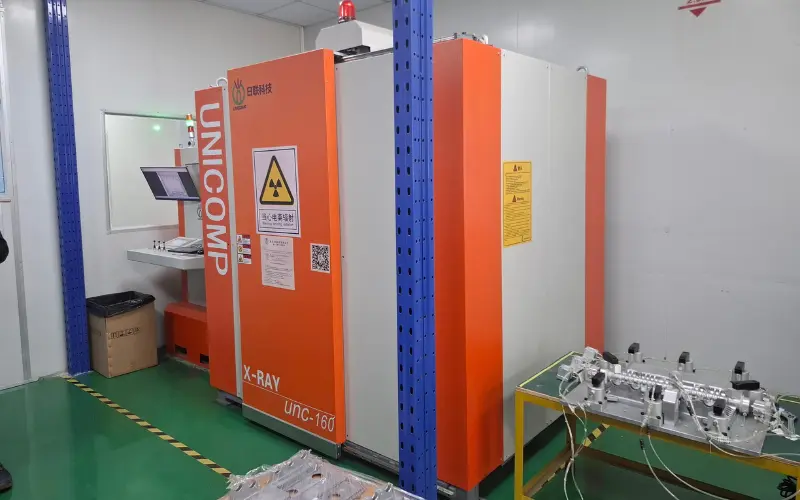 Real-time X-ray inspection verifies internal integrity where medical programs cannot tolerate hidden porosity.
Medical Die Casting FAQ
Q: Can die casting meet the tolerances medical devices require?
A: Yes — for the vast majority of structural and enclosure applications, HPDC with CMM-verified process control holds the envelope consistently. Where sub-millimeter features are machined, we finish in-house so the casting and machining are one accountable process.
Q: How is material quality assured for medical components?
A: Every melt heat is analyzed by spectrometer before injection, and incoming ingot carries material certification. Critical parts receive X-ray NDT and full dimensional reports.
Q: Do you provide PPAP documentation for medical programs?
A: We prepare PPAP Level 3 packages with traceable records, dimensional results, and a controlled change history suitable for regulated supply chains.
Q: Which alloys are typical for medical die casting?
A: Aluminum A380/ADC12/A356 for structural and thermal parts, and magnesium AZ91D/AM60B where lightweighting is decisive. Alloy choice is matched to sterilization, strength, and weight targets in the DFM phase.
Request a Quote for Medical Die Casting
If your team is evaluating die casting for a medical equipment or device component, send your STEP/IGS models and print drawings. Within 24 hours our engineering desk will return an initial DFM review and a direct quotation, with the process discipline medical programs require.
Explore our core aluminum die casting and medical device component machining capabilities, or start a conversation via contact.
Ready to start your project?
Talk to AlumCasting engineers about your casting, machining and tooling requirements.